


ESET Research discovers scheme to steal cryptocurrency from Android and iPhone users

If you’ve spent any time in the networking trenches, you’ve no doubt spent many hours puzzling over an assortment of network topology charts. These visual representations of a network tell an important story of how the various components in a network are connected to each other and how data is transferred between its constituent nodes.
These topologies are more than just fancy diagrams – they essentially serve as a living blueprint that describes how a network functions and data is routed. Choosing the right topology will go a long way towards improving the performance and efficiency of your network, as well as help to rationalize how certain resources should be allocated and can provide a roadmap that’s essential for troubleshooting when network connectivity issues arise.
Over the past few decades, a wide variety of network topologies have been established, each of which caters to a specific environment or use case. However, as the network continues its inexorable march towards the edge – where connectivity can be intermittent and skilled resources are scarce – we will likely see a number of new topologies arise that take these constraints into consideration.
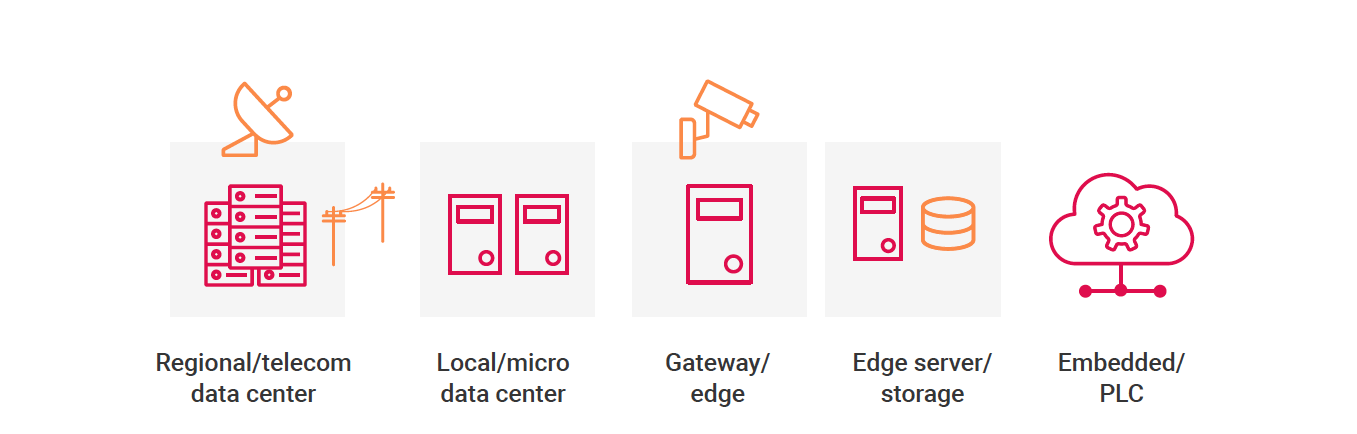
As Alan R. Earls, author of The Gorilla Guide to: Enabling IT at the Edge, notes in his explanation of the most likely edge topologies: “While the never-ending evolution of information technologies makes it hard to predict exactly what topologies will emerge or seem most appealing in the future, there are currently several strong contenders for edge computing.” These five edge topologies include:
1. Regional Data Center Edge: CDN, Telecom DC, Colocation.
This might be a service provider configuration with multiple tenants and, in comparison with other edge computing scenarios, is typically a very large-scale operation that differs from a traditional data center only in its relationship to an even larger central data center and in usually having a narrower focus.
2. Local Data Center Edge: Small Data Center, Micro Data Center.
This type of edge computing is likely general-service-oriented, perhaps for a remote office or branch office and is characterized by low or no staffing.
3. Gateway Edge: Intelligent Local/Field Gateway
This typically comprises a small cell or access point, such as a video management software (VMS) surveillance system and offers zero touch provisioning (ZTP) and configuration management.
4. Device Edge: Embedded Computing Devices and Traditional PLCs.
This type of edge, typically a single machine or work cell, has only enough intelligence to assist with a specific operation and provide some de- gree of reporting.
5. Compute Edge: Edge Server/Storage Outside of a Data Center.
Examples of this type of true edge computing potentially have the ability to include specialized services, such as video analytics-based applications and likely include ZTP.
It’s important to note that these topologies aren’t rigid. There are gray areas and some edge implementations can actually include multiple topologies. However, in most instances, one is clearly predominant.
To learn more about what future edge topologies might look like, download Scale Computing’s free ebook: “The Gorilla Guide to: Enabling IT at the Edge”