


Segura 4.2.16 JIT Privilege: A Practical PAM Upgrade Guide for IT Teams
CyberLink FaceMe Security 8.9.2: On-Camera AI Access Control
For Hong Kong organisations managing office buildings, retail branches, campuses, logistics sites or controlled facilities, physical access security increasingly sits alongside IT security. Cameras and access-control systems are connected to corporate networks, identity databases and video-management platforms. That creates opportunities for more efficient operations, but it also raises questions about privacy, resilience, integration and long-term support.
CyberLink’s FaceMe® Security 8.9.2 update, announced in October 2026, is notable because it moves the facial-recognition workload onto compatible Axis cameras. It also adds AI-assisted investigation tools and a more structured alarm workflow. For buyers, the release is a useful prompt to reassess the architecture of a multi-site access-control deployment rather than simply compare recognition accuracy or camera specifications.
What changes in FaceMe Security 8.9.2?
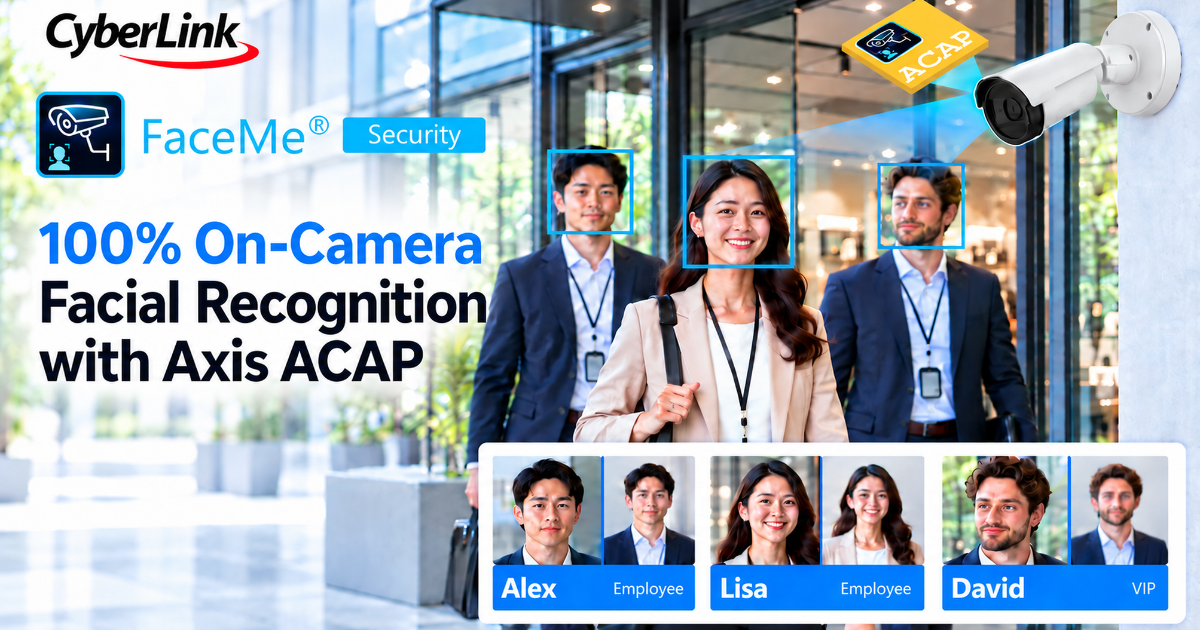
The key change is support for fully on-camera facial recognition through the FaceMe Security ACAP application on compatible Axis cameras powered by the ARTPEC-9 system-on-chip. Face detection and 1:N identity matching can run on the camera itself, removing the need for a dedicated recognition workstation at each location.
FaceMe Security Central continues to handle management functions such as face enrolment, people databases and recognition-event review. CyberLink says Central can be deployed on premises or hosted in a customer’s own cloud environment, including AWS. In an on-premises deployment, operators can continue using Axis Camera Station or an existing video-management system for live viewing and recording, with match results displayed over the video stream.
This separation is important for architecture planning: recognition processing may be distributed to the camera, while administration and event review remain centrally managed. It can simplify the edge footprint, but buyers still need to design the management layer, connectivity, storage, access permissions and operational support.
Why on-camera processing matters to multi-site operators
Traditional deployments may require a recognition workstation or server at each site. Across a Hong Kong retail chain, property portfolio or logistics network, that can mean additional hardware procurement, installation, power, rack or cabinet space, patching and replacement planning.
Moving recognition to compatible cameras can reduce those dependencies and make it easier to add coverage incrementally. A branch may be able to add another supported camera without sizing a separate recognition PC for every entrance. It may also reduce the amount of recognition traffic that needs to travel to a central server, depending on how the wider system is configured.
Compatibility must be checked carefully. CyberLink specifies ARTPEC-9 cameras for 100% on-camera recognition. Do not assume that every Axis camera, every firmware version or every existing FaceMe deployment supports the same operating model. Confirm camera models, firmware, ACAP application requirements, licensing, network design and the role of FaceMe Security Central before committing to a rollout.
Operational gains: investigations, alarms and visitor visibility
Version 8.9.2 also introduces support for compatible AI agents that can search, analyse and summarise recognition records through natural-language requests. Examples described by CyberLink include summarising the day’s recognition events, identifying employees without a recorded entry event, preparing weekly attendance reports and creating shift-handover summaries.
The MCP server used for this integration is deployed on premises, allowing customers to align the service with their own security policies. That is a useful design consideration, but it does not remove the need to govern which records an AI agent can access, which users can submit queries, how requests are logged and how generated summaries are checked before being used in an investigation or management decision.
The update also adds a structured alarm workflow. A team can review an incoming alarm, assign a handler, set priority and response instructions, record the outcome and have a reviewer verify closure. This gives each event an owner and a traceable path from detection to resolution. For a site with several security shifts or a central control room overseeing multiple buildings, that can help reduce alarms that are duplicated, missed or left without a clear owner.
Face Terminal can now record entry and exit on one device, giving staff a current view of who is on site and a visit history for reporting. Registered people groups, including employees, VIPs, visitors and blocklists, can also be shared across multiple FaceMe Security Central systems and synchronised daily.
Performance claims should be tested in your own environment
CyberLink reports that its internal testing on an AXIS Q3548-LVE camera processed 510 people per hour against a database of 10,000 faces while using approximately 20% of the camera’s CPU resources. The company also says recognition continues on the camera during a network interruption and that records synchronise automatically after connectivity is restored. Data stored on the camera is protected with encryption.
These are useful data points, not a substitute for a site pilot. Real performance depends on camera placement, lighting, movement, crowd density, face angle, database size, network conditions and the organisation’s acceptance thresholds. Ask the vendor or integrator to demonstrate the system with representative entrances and realistic traffic patterns. Measure both false acceptance and false rejection, and establish a manual process for visitors or staff who cannot be recognised reliably.
Privacy must be part of the design, not an afterthought
Facial recognition involves biometric information. Hong Kong’s Office of the Privacy Commissioner for Personal Data has published guidance on the collection and use of biometric data, emphasising that organisations should justify the purpose, consider whether less privacy-intrusive alternatives can achieve it, assess privacy impact and put appropriate procedural and technical safeguards in place.
For Hong Kong buyers, this means asking whether facial recognition is necessary for the specific entrance or process. A card, mobile credential, staffed reception or another less intrusive method may be sufficient in some settings. If biometric recognition is justified, define the purpose clearly, provide appropriate notices, restrict access to enrolment and recognition records, establish retention and deletion rules, protect data in transit and at rest, and prevent information collected for one purpose from being reused for an unrelated purpose without a proper basis.
On-camera processing can change where recognition computation takes place, but it does not automatically resolve privacy obligations. The organisation should understand what images, templates, match results and event records are stored on cameras, in FaceMe Security Central, in the VMS and in any connected reporting or AI workflow. Include the integrator and cloud provider in the data-flow assessment where they handle personal data.
A buyer’s checklist for Hong Kong deployments
- Confirm compatibility: verify the exact Axis camera models, ARTPEC-9 support, firmware, ACAP requirements, licensing and management-server version.
- Map the data flow: document where enrolment data, templates, images, match results, visitor records and alarms are processed and stored.
- Review privacy necessity: record the operational reason for using biometrics and assess whether a less intrusive alternative is practical.
- Set access boundaries: use role-based permissions for enrolment, database changes, event searches, alarm handling and exports.
- Test offline behaviour: disconnect a test camera, confirm recognition continuity, inspect local storage protections and verify synchronisation after reconnection.
- Validate AI governance: keep the MCP server within the approved security boundary, limit accessible records and require human review of consequential findings.
- Test alarm ownership: simulate an alarm across shift changes and verify assignment, escalation, evidence capture and closure review.
- Plan lifecycle support: agree who patches cameras, ACAP applications, management servers and VMS components, and how failures are escalated.
Run a controlled 30-day pilot
During week one, select one representative entrance and map the existing camera, VMS, network and identity architecture. Confirm the business purpose for recognition and complete a privacy and data-flow review before enrolling real users.
During week two, test the supported camera and ACAP deployment with a controlled dataset. Measure recognition performance under different lighting and traffic conditions, verify the camera’s resource use, and test what happens when the network is interrupted.
During week three, evaluate event searches, AI-assisted summaries and alarm assignment with security operators. Check that permissions match job roles and that an operator cannot retrieve records beyond the approved scope.
During week four, review the results with IT, facilities, privacy and security stakeholders. Compare the total cost of ownership with the existing workstation-based design, including camera upgrades, licences, integration, support and data-retention costs. Expand only when the operational and privacy controls are proven.
Make the architecture decision before buying more cameras
FaceMe Security 8.9.2 gives Hong Kong organisations a different way to design facial-recognition deployments: compatible cameras can perform recognition locally, while central management, investigation and alarm workflows remain available to security teams. The potential benefit is a simpler edge footprint and more organised operations across multiple sites.
The strongest buying decision will still depend on compatibility, privacy necessity, measurable accuracy, resilience and integration with the organisation’s existing access-control and video systems. Treat the new capabilities as a reason to run a disciplined pilot, not as a reason to deploy biometrics everywhere. A well-governed design should improve physical security while keeping personal data, operational accountability and long-term support firmly in view.
About CyberLink
Founded in 1996, CyberLink Corp. (5203.TW) is the world leader in multimedia software and AI facial recognition technology. CyberLink addresses the demands of consumer, commercial and education markets through a wide range of solutions, covering digital content creation, multimedia playback, video conferencing, live casting, mobile applications and AI facial recognition. CyberLink has shipped several hundred million copies of its multimedia software and apps, including the award-winning PowerDirector, PhotoDirector, and PowerDVD. With years of research in the fields of artificial intelligence and facial recognition, CyberLink has developed the FaceMe® Facial Recognition Engine. Powered by deep learning algorithms, FaceMe® delivers the reliable, high-precision, and real-time facial recognition that is critical to AIoT applications such as smart retail, smart security, and surveillance, smart city and smart home. For more information about CyberLink, please visit the official website at www.cyberlink.com
About Version 2
Version 2 Digital is one of the most dynamic IT companies in Asia. The company distributes a wide range of IT products across various areas including cyber security, cloud, data protection, end points, infrastructures, system monitoring, storage, networking, business productivity and communication products.
Through an extensive network of channels, point of sales, resellers, and partnership companies, Version 2 offers quality products and services which are highly acclaimed in the market. Its customers cover a wide spectrum which include Global 1000 enterprises, regional listed companies, different vertical industries, public utilities, Government, a vast number of successful SMEs, and consumers in various Asian cities.
Contact us
to explore more
Schedule a demo, start a free trial, or request a quote, and more
We are here to assist you every step of the way.
- +852 2893 8860
- sales@version-2.com
- +852 9843 8129