


Actiphy ImageServer: A Practical Backup Resilience Upgrade for IT Teams
Guardz Alert Overload: A Practical Guide for MSPs
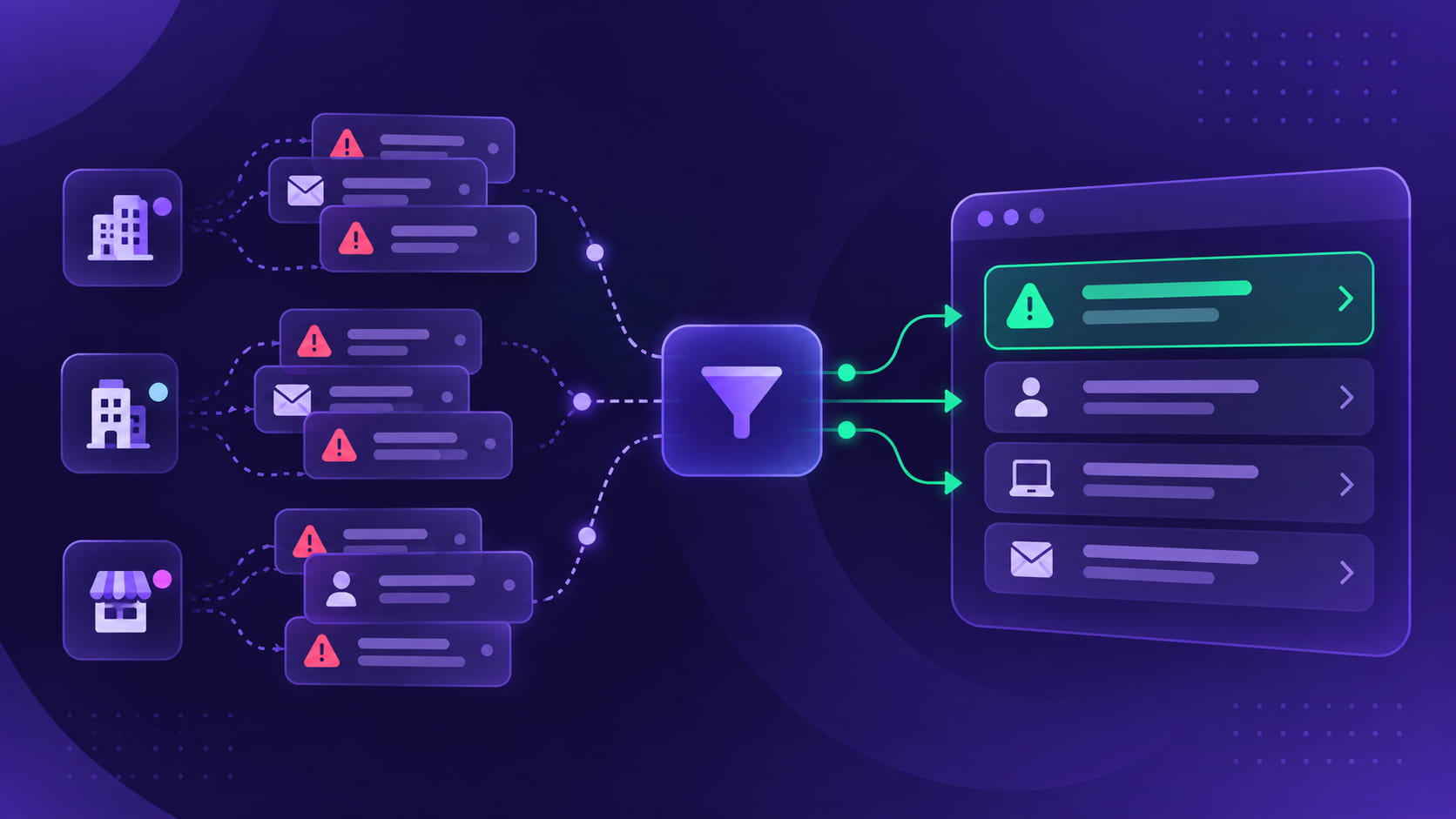
For a managed service provider (MSP), a crowded alert queue is not simply an inconvenience. It can delay containment, consume technician time and make it harder to demonstrate service quality to customers. Guardz’s November 4, 2026 guide to alert overload sets out a practical operational response: reduce duplicate and low-value work while preserving the ability to detect genuine incidents.
Why alert volume becomes a business problem
MSPs often support many customer environments with different working hours, applications, identities and risk profiles. If every tenant shares identical thresholds, normal activity for one customer can generate repeated warnings. Disconnected security tools can also report the same event independently, leaving technicians to reconstruct one incident from several consoles.
The cost is measured in slower acknowledgement and escalation, not just the number of notifications. A suspicious sign-in, for example, may be more consequential when it coincides with an unexpected mailbox rule or endpoint activity. When these signals remain separate, analysts must spend time collecting context before deciding whether to act.
Start with an alert audit, not a blanket reduction
Before changing detection rules, review a representative period across customer tenants. Record the alert source, rule, severity, disposition, handling time and whether another alert led to the same investigation. Classify findings as false positives, duplicates, actionable threats or accurate but non-urgent events.
Include quiet tenants in the review. A low alert count may mean that monitoring is working well, but it may also indicate a disconnected data source or failed integration. Validate collection health before treating a quiet queue as evidence of low risk.
Five practical ways to reduce alert fatigue
1. Remove duplicate investigation work
Map each security control to the activity it detects. Where two tools report the same event, confirm that the retained control provides adequate coverage before removing anything. If both controls are needed, route related detections into one case while preserving the original evidence and source details.
2. Tune thresholds for each customer
Build a baseline for each tenant: normal business hours, sign-in locations, administrative tools, privileged accounts and expected endpoint behaviour. A rule that is useful for a conventional office may create noise for a customer with shift workers or regional operations. Keep exceptions narrow, documented and time-limited, then revisit them when the customer changes.
3. Automate preparation before automating closure
Low-risk automation can enrich alerts, group duplicates and route work to the right queue. Closing alerts automatically is a higher-risk step. Only use it for tested conditions, log every decision, sample closed cases and provide a way to reopen an investigation when new evidence appears. Anything outside the tested rules should reach a technician.
4. Agree escalation ownership in advance
Define who owns each severity level, the expected response target, customer contacts and after-hours coverage. Decide in advance who is authorised to suspend an account, isolate a device, approve restoration and communicate with the customer. This avoids losing time during an incident while teams work out who can approve containment.
5. Measure response outcomes
Guardz highlights mean time to acknowledge (MTTA), mean time to respond (MTTR), mean time to escalation (MTTE), unresolved high-severity issues and detection trends by control. Use consistent definitions. Separate the time to begin a response from the time to contain and fully resolve an incident, otherwise a quick first action can hide unfinished work.
What to test when evaluating an alert-management platform
Hong Kong MSPs should test a candidate solution with representative customer scenarios rather than relying on a feature checklist. Ask whether identity, email and endpoint findings can be correlated into one investigation, whether analysts can inspect the evidence behind prioritisation, and whether customer data remains separated in a multi-tenant view.
- Can technicians see the originating tenant, affected assets and event timeline?
- Can they identify why an alert was prioritised and challenge an incorrect decision?
- Are automated response actions bounded by clear approval rules?
- Can reports show incidents, remediation and remaining exposure without manual reconstruction?
- Can the MSP verify that tuning has not reduced detection coverage?
Guardz describes its own approach as combining signals from identity, email, endpoint and cloud controls, AI-assisted triage, and expert MDR investigation. Its guide also describes multi-tenant views and client reporting. These are vendor-described capabilities; MSPs should validate the actual workflows, integrations, service scope and response permissions in a trial against their own operating requirements.
Considerations for Hong Kong service providers
Local MSPs may support customers with different languages, business hours, regulatory obligations and data-handling requirements. Make tenant separation, access control, auditability and incident communications part of the evaluation. Confirm where logs and investigation data are processed and retained, who can access them, and how customer-specific retention or deletion requirements are handled.
For a small security team, alert management is ultimately a service-capacity issue. The goal is not to make the dashboard look quieter; it is to make sure the right person sees the right evidence in time to act. A measured audit, tenant-aware tuning, controlled automation and clear escalation ownership provide a safer starting point than simply suppressing alerts.
About Guardz
Guardz is on a mission to create a safer digital world by empowering Managed Service Providers (MSPs). Their goal is to proactively secure and insure Small and Medium Enterprises (SMEs) against ever-evolving threats while simultaneously creating new revenue streams, all on one unified platform.
About Version 2
Version 2 Digital is one of the most dynamic IT companies in Asia. The company distributes a wide range of IT products across various areas including cyber security, cloud, data protection, end points, infrastructures, system monitoring, storage, networking, business productivity and communication products.
Through an extensive network of channels, point of sales, resellers, and partnership companies, Version 2 offers quality products and services which are highly acclaimed in the market. Its customers cover a wide spectrum which include Global 1000 enterprises, regional listed companies, different vertical industries, public utilities, Government, a vast number of successful SMEs, and consumers in various Asian cities.
Contact us
to explore more
Schedule a demo, start a free trial, or request a quote, and more
We are here to assist you every step of the way.
- +852 2893 8860
- sales@version-2.com
- +852 9843 8129