Architectural Crisis: Broken Access Control in the Era of Agentic AI
Threat Intelligence Briefing: The Industrialization of Cloud Phishing

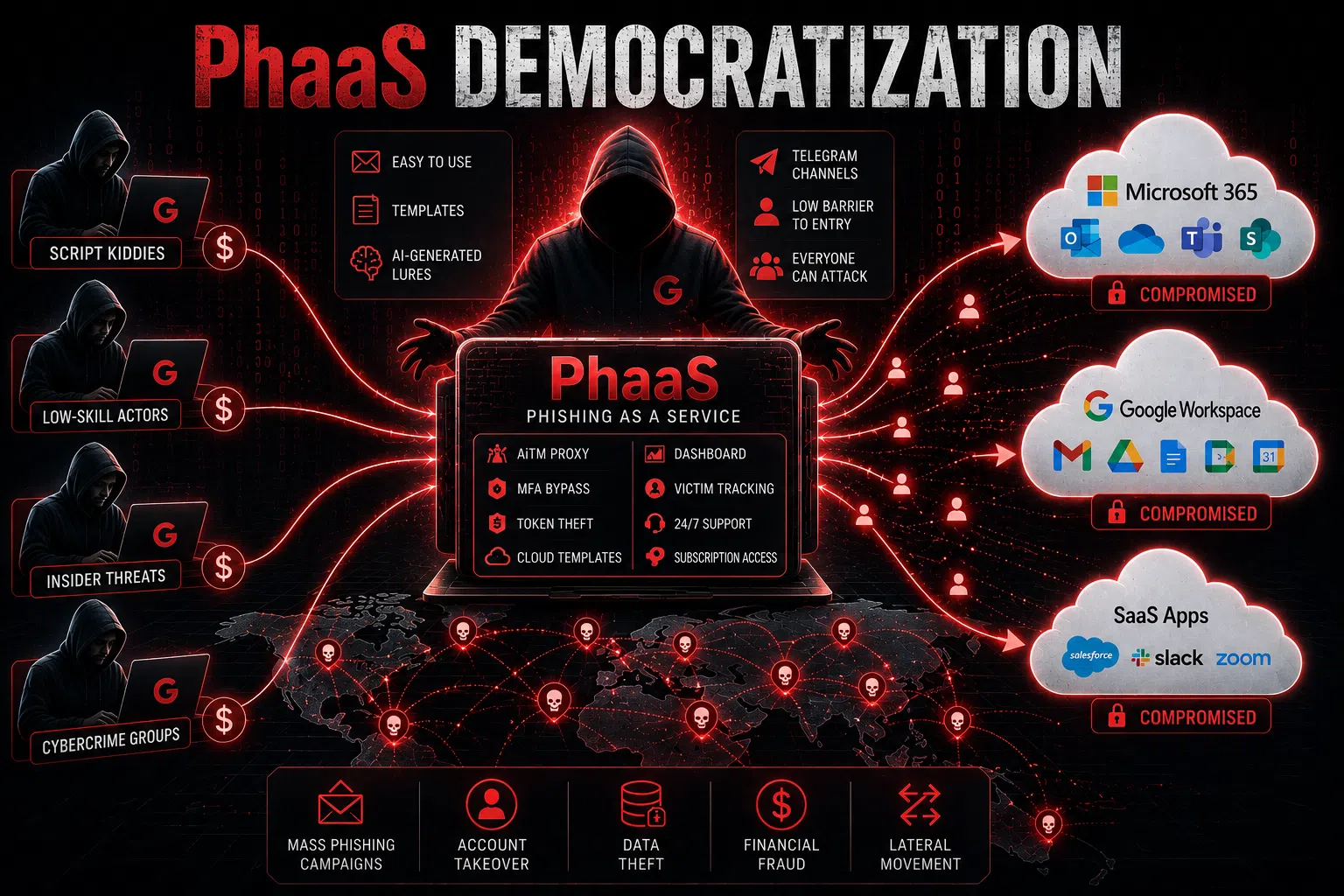
Commoditizing the Cloud Breach
Strategic Analysis of Phishing-as-a-Service (PhaaS) Democratization and Token-Centric Exploitation
Strategic Briefing: The capital requirements for orchestrating enterprise-grade cloud compromises have collapsed. For a baseline subscription fee of $500, malicious actors can bypass advanced technical barriers to execute Adversary-in-the-Middle (AiTM) and OAuth device-code operations across premium cloud tenants like Microsoft 365 and Google Workspace. This shift represents the industrialization of deception architecture, changing the risk profile of modern identity perimeters.
The Skill Inversion
Turnkey cloud platforms have abstracted complex exploit design into standard point-and-click operations, allowing low-tier threat actors to bypass multi-factor authentication (MFA) natively.
SaaS Business Model
Mirroring the Ransomware-as-a-Service (RaaS) franchise structure, PhaaS separates elite backend software engineering from low-risk frontend deployment.
Token-Centric Target
Defensive paradigms must evolve beyond simple credential theft; modern campaigns focus heavily on intercepting session tokens and abusing OAuth device authentication states.
The Mechanics of Democratic Proliferation
The democratization of Phishing-as-a-Service represents a significant evolution in the cybercrime market, following a path similar to Ransomware-as-a-Service (RaaS). Attacks that once required specialized engineering teams and custom command-and-control infrastructure are now packaged into commercial subscription models accessible to non-technical operators.
Three primary structural pillars accelerate this current wave of mass compromise:
- The Crime-as-a-Service (CaaS) Ecosystem: Following the operating models established by legacy ransomware syndicates like LockBit, modern PhaaS maintain a clear division of roles. Core engineering groups build and maintain the offensive infrastructure, while decentralised affiliates purchase access to run individual target campaigns.
- Uncensored Large Language Models (LLMs): The integration of fine-tuned, uncensored open-source models (such as customized Llama frameworks) removes traditional language barriers. These tools automate hyper-personalized open-source intelligence (OSINT) harvesting, eliminate grammatical indicators of fraud, and programmatically generate polymorphic variants to bypass content security gateways.
- Advanced Authentication Abuse Primitives: Modern toolkits prioritize token interception over traditional password harvesting. By hijacking legitimate identity authorization workflows—such as Microsoft’s native
microsoft.com/deviceloginchannel—attackers can bypass conditional access parameters and some traditional MFA implementations.
The Threat Imbalance: Threat intelligence indicators from 2025–2026 show that approximately 85% to 90% of high-volume phishing infrastructure is now driven by commodity PhaaS platforms, scaling threat operations at an industrial level.
Emerging Toolkits of the 2026 Threat Landscape
The current threat matrix is defined by rapid platform iteration, anti-analysis protocols, and deep integration with automated post-compromise frameworks. Rather than pursuing ephemeral access, these platforms focus on establishing persistent token residency.
| Platform Name | Market Ingress | Primary Exploitation Vector | Integrated AI Automation Layers |
|---|---|---|---|
| Kali365 | April 2026 | OAuth Device Code Abuse (Abusing native Microsoft device login channels) | Automated lure generation, dynamic template matching, real-time telemetry analytics. |
| EvilTokens | March 2026 | Hybrid AiTM Proxy meshes combined with Device Authorization Flow hijacking | Automated post-compromise mailbox triage, context-aware Business Email Compromise (BEC) scripting. |
| Whisper 2FA | Active 2026 | High-velocity Adversary-in-the-Middle (AiTM) reverse proxy generation | Adaptive phishing flows that alter presentation layer signatures in real time based on user agent sniffing. |
Commercial Structures of the Cybercrime Market
PhaaS subscription models closely track legitimate enterprise software pricing tiers, with access to advanced capabilities restricted by subscription level:
- Basic Tier ($100 – $300 / month): Standard static web templates, baseline reverse-proxy modules, and public community forum support.
- Pro Tier ($400 – $800 / month): Full integration with uncensored generative AI models, polymorphic lure variation engines, and automated multi-vector evasion matrices.
- Enterprise Tier ($1,000 – $3,000+ / month): Dedicated infrastructure pools, custom feature engineering, exclusive zero-day exploit pathways, and direct revenue-sharing operational models.
Post-Exploitation Lifecycle Automation
Once a session token or refresh token is successfully intercepted via an AiTM proxy or device authorization link, modern PhaaS toolkits execute automated scripts to ensure persistent access and control:
- Automated Device Enrollment: The toolkit programmatically signs a new, attacker-controlled system into the victim’s tenant, blending in with standard enterprise onboarding activity to fulfill device-based Conditional Access policies.
- Persistence Mechanism Implementation: Internal mailbox routing is altered using automated inbox rules, hiding outbound data flows and enabling quiet monitoring of internal communications.
- Authentication Method Proliferation: Attackers register alternative MFA factors (such as rogue authenticator apps or SMS endpoints) under the compromised account identity to survive standard password resets.
- Graph API and Data Exfiltration: Automated tools query Microsoft Graph or Google Workspace directories to extract high-value datasets from SharePoint Online and OneDrive, focusing on financial structures, active contracts, and internal credential vaults.
Forensic Deep Dive: Technical Signatures in Entra ID Logs
From an incident response perspective, an automated token-replay attack leaves subtle, distinct indicators across cloud audit logs. Review this simulation of typical attacker movement and log trails:
# Phase 1: Attack Broker Silent Token Redemption
Sign-in Status: Success
Application: Microsoft Authentication Broker
Resource: OfficeHome Gateway
Error History: 50199 (Conditional Access Transient Block) -> Resolved via immediate retry
MFA Attestation: “Satisfied by claim in token” (Indicates automated session replay via existing refresh token)# Phase 2: Device Code Flow Hijack Audit
Authentication Protocol: Device Code Flow
Target: Microsoft Graph API
User Agent Signature: Mobile App / Desktop Client combination running concurrently
Action: Silent extraction of secondary access tokens using pre-approved user authorization parameters
Sign-in Status: Success
Application: Microsoft Authentication Broker
Resource: OfficeHome Gateway
Error History: 50199 (Conditional Access Transient Block) -> Resolved via immediate retry
MFA Attestation: “Satisfied by claim in token” (Indicates automated session replay via existing refresh token)# Phase 2: Device Code Flow Hijack Audit
Authentication Protocol: Device Code Flow
Target: Microsoft Graph API
User Agent Signature: Mobile App / Desktop Client combination running concurrently
Action: Silent extraction of secondary access tokens using pre-approved user authorization parameters
# Phase 3: Rogue Endpoint Workplace Join Simulation
Operation Type: Register device
Service Category: Device Registration Service
Enrolled Endpoint Client: Dsreg/10.0 (Windows 10.0.19045.2006)
Strategic Context: Attacker maps a new workstation into the tenant to appear as a compliant corporate asset
Defensive Countermeasures: Guardz ITDR Architecture
Defending against automated, machine-speed PhaaS operations requires security monitoring that can correlate identity indicators across different vectors in real time. Guardz Identity Threat Detection and Response (ITDR) is engineered to neutralize these highly automated attacks before lateral movement can occur.
Real-Time Session Revocation with Guardz
Guardz ITDR protects the enterprise perimeter by monitoring session data and identifying atypical access behaviors across the entire identity landscape:
- Multi-IP Session Replay Detection: If a valid session is reused from an unrecognized IP address seconds after a legitimate interactive login, Guardz identifies the anomaly, flags the unusual use of the Microsoft Authentication Broker, and alerts security teams.
- Cross-Vector Security Correlation: Guardz automatically links an initial Browser AiTM session replay event with concurrent device code requests, mapping the full attack chain to a single compromised identity profile.
- Automated Containment: Rather than waiting for manual intervention, Guardz triggers automated session revocation playbooks the moment token theft is confirmed, invalidating compromised access states across the entire tenant structure.
Block commodity cloud compromise at the identity layer. Contact our identity protection engineers to deploy automated session security across your architecture.
About Guardz
Guardz is on a mission to create a safer digital world by empowering Managed Service Providers (MSPs). Their goal is to proactively secure and insure Small and Medium Enterprises (SMEs) against ever-evolving threats while simultaneously creating new revenue streams, all on one unified platform.
About Version 2
Version 2 Digital is one of the most dynamic IT companies in Asia. The company distributes a wide range of IT products across various areas including cyber security, cloud, data protection, end points, infrastructures, system monitoring, storage, networking, business productivity and communication products.
Through an extensive network of channels, point of sales, resellers, and partnership companies, Version 2 offers quality products and services which are highly acclaimed in the market. Its customers cover a wide spectrum which include Global 1000 enterprises, regional listed companies, different vertical industries, public utilities, Government, a vast number of successful SMEs, and consumers in various Asian cities.